
SCOTSS

Space-based Innovation and Digitalization for the School of Tomorrow

SCOTSS Educational Platform

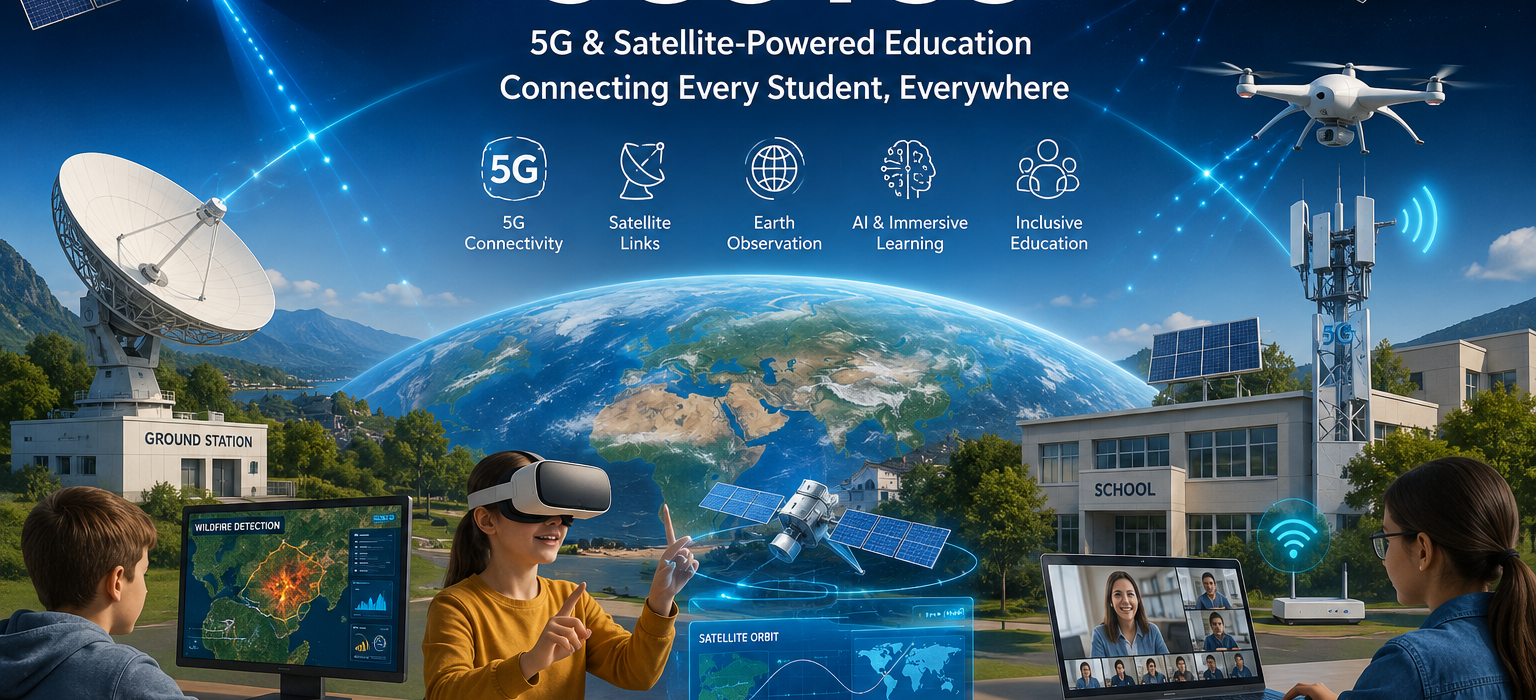
The SCOTSS project introduces an innovative educational platform powered by 5G and satellite communications, designed to deliver advanced learning experiences to students regardless of their geographical location. By combining Artificial Intelligence (AI), Virtual and Augmented Reality (VR/AR), and Earth Observation (EO) technologies, the platform creates immersive, interactive, and inclusive educational environments that bridge the digital divide and promote equal access to quality education.

  • Universal Educational Connectivity: A primary objective of SCOTSS is to maintain uninterrupted communication between students and teachers, even in regions where terrestrial broadband infrastructure is unavailable or limited. Through the integration of terrestrial 5G networks with satellite-based 5G backhauling, the platform provides reliable, high-throughput connectivity to remote islands, rural communities, mountainous areas, and refugee camps, ensuring equal educational opportunities for all learners.

  • Ground Station as the Core Infrastructure: At the heart of the platform is the Ground Station (Earth Station - ES), serving as the central communication hub between the educational ecosystem and satellites in orbit. The Ground Station receives, processes, and distributes satellite imagery, telemetry, and communication data, enabling both real-time and archived access to valuable space-derived information. Supporting both local operation and remote management through high-speed 5G connectivity, it provides a flexible infrastructure suitable for a wide range of educational scenarios.

  • Earth Observation and Environmental Applications: The platform incorporates Earth Observation data directly into the educational process, allowing students to analyze real satellite imagery and investigate environmental phenomena such as wildfires, oil spills, floods, coastal pollution, and agricultural activities. By working with authentic satellite datasets, learners develop practical skills in environmental monitoring, geospatial analysis, and data interpretation while understanding the societal impact of space technologies.

  • Experiential Space Education: Students actively engage with satellite communications, orbital mechanics, and modern space technologies through hands-on educational activities. The platform enables learners to design and execute their own virtual satellite missions, receive real satellite data, and perform mission analysis, providing an authentic experience that connects theoretical knowledge with practical engineering and scientific applications.

  • Immersive Digital Learning: Artificial Intelligence and Virtual/Augmented Reality technologies transform traditional teaching into interactive experiences. Students explore virtual laboratories, visualize satellite operations in three-dimensional environments, and collaborate within immersive digital classrooms, significantly enhancing engagement, creativity, and critical thinking while supporting personalized learning pathways.

The SCOTSS platform demonstrates how the convergence of 5G, satellite communications, AI, Earth Observation, and immersive technologies can redefine digital education. By providing equitable access to advanced educational resources and authentic space-based applications, the project empowers students with the knowledge and skills required for the next generation of digital and space-enabled societies.

Space-Based Education Platform

The proposed educational platform leverages satellite communications, Earth Observation, and space technologies to create an innovative learning environment where students actively engage with real-world space data and advanced digital applications. By integrating satellite infrastructure, 5G connectivity, virtual laboratories, and immersive technologies, the platform transforms theoretical concepts into interactive educational experiences.

  • Satellite Communications and 5G Integration: Satellite communications serve as a key component for the realization of 5G backhaul services. A dedicated satellite ground station captures telemetry and Earth Observation data from amateur satellites through scheduled and on-demand requests. The collected data are distributed via a cloud-enabled 5G platform, enabling teachers and students to access satellite imagery, measurements, and mission information from anywhere within the educational community.

  • Virtual Satellite Laboratory: Students participate in an interactive virtual laboratory where they study satellite trajectories, orbital mechanics, and communication principles using real satellite passes. Through visualization tools and orbital simulations, learners gain practical understanding of satellite navigation, orbital dynamics, and the operation of modern space communication systems while interacting directly with data received by the ground station.

  • Earth Observation for Environmental Education: High- and medium-resolution satellite imagery provides valuable insights into environmental phenomena. Students analyze real Earth Observation data to investigate challenges such as sea pollution, marine and beach litter, wildfires, and ocean planktonic slime along coastal windrows. The platform also supports the integration of airborne vehicles, allowing satellite observations to be complemented with aerial imagery for enhanced environmental monitoring and analysis.

  • Satellite Navigation and Spatial Understanding: Interactive simulations of Global Navigation Satellite System (GNSS) constellations help students understand satellite positioning, orbital geometry, and three-dimensional spatial relationships. By following live satellite passes through the ground station, learners develop practical knowledge of how navigation satellites operate and how positioning services are delivered worldwide.

  • International Space Station and Immersive Learning: The platform introduces students to the scientific missions and technologies of the International Space Station (ISS), highlighting their contribution to future space exploration and everyday life on Earth. Using the Mission: ISS virtual reality application together with the proposed educational environment, students experience life aboard the ISS before progressing to the creation of their own virtual three-dimensional space station. Through simulation activities, they investigate operational procedures, sustainability challenges, and system viability while applying engineering and scientific principles in a collaborative learning environment.

Overall, the platform combines satellite communications, Earth Observation, 5G networking, virtual reality, and interactive simulations to foster creativity, critical thinking, digital skills, and scientific curiosity. By exposing students to authentic space technologies and real satellite data, it bridges classroom learning with modern space applications while inspiring the next generation of scientists, engineers, and innovators.

5G & Satellite Connectivity

Hybrid communication infrastructure combining 5G terrestrial networks with satellite-based backhauling to provide reliable, high-speed educational connectivity for remote islands, rural communities, and underserved regions.

Satellite Ground Station

An advanced Earth Station (ES) capable of receiving, processing, and distributing satellite imagery, telemetry, and communication data while supporting both local and remote operation through the 5G network.

Earth Observation

Real satellite imagery and geospatial data enable students to investigate environmental challenges such as wildfires, oil spills, marine pollution, floods, and agricultural monitoring through hands-on analysis.

AI, VR & AR Learning

Integration of Artificial Intelligence (AI), Virtual Reality (VR), and Augmented Reality (AR) to create immersive educational experiences, virtual laboratories, and interactive space mission simulations.

Future Space Technologies

The SCOTSS CCN extends the platform with nano-satellites, Mixed Reality (MR), metaverse-based learning, and Fixed Wireless Access (FWA), creating the next generation of digital education for the School of Tomorrow.

University of Piraeus Logo
University of Piraeus

The University of Piraeus Research Center (UPRC) is a well-established institution with strong recognition. Its Department of Digital Systems focuses on areas such as broadband and network services and cybersecurity. Overall, the institution contributes advanced expertise in 5G and satellite networks, cloud computing, Artificial Intelligence and Machine Learning, and Digital Twin technologies.

University of the Aegean Logo
University of the Aegean

The University of the Aegean – Computer and Communication Systems Laboratory (CCSL) brings space-related curricula and technologies, as well as a proven record of providing robust research and practical solutions in the field of next-generation heterogeneous, wireless, mobile, and satellite broadband systems and networks.

Cloud Signals Logo
Cloud Signals

Cloud Signals is an SME and an incubatee of ESA BIC Greece, actively operating in the field of 5G and satellite convergence. The company is currently conducting pilots using live 5G networks to provide satellite backhaul, direct connectivity, and related services to users. Cloud Signals is developing a product bundle based on a Network as a Service (NaaS) business model, connecting the core network to the gNB (Next Generation NodeB) of a cellular mobile network through satellite communications.

Ellinogermaniki Agogi Logo
Ellinogermaniki Agogi

Ellinogermaniki Agogi is one of the most innovative schools in Europe. The school operates as a living laboratory for the design and development of the technology-supported school of tomorrow. Numerous innovative projects, educational methodologies, and technological initiatives are designed, implemented, and evaluated within the school environment. Ellinogermaniki Agogi maintains close cooperation with the Institute of Educational Policy of the Greek Ministry of Education and has made significant contributions to the design and implementation of current educational reform efforts in Greece.

COSMOTE Logo
COSMOTE

COSMOTE, the leading mobile network operator in Greece, will provide a real and live 5G Node for the satellite backhaul to remote schools. Its telecommunications infrastructure and technical expertise will support the implementation, validation, and demonstration of integrated 5G and satellite communication services under real operational conditions.

Omega Technology Logo
Omega Technology

Omega Technology is an information technology services company providing advanced solutions for 3D applications, assisted-living systems, e-commerce applications, e-learning platforms, document and knowledge management systems, and on-demand software. Within the project, the company contributes its expertise in the development of interactive digital services, educational platforms, and innovative technology-supported learning applications.

Hellas Sat Logo
Hellas Sat

Hellas Sat is a leading satellite operator offering services across Europe, the Middle East, and Southern Africa. Established in August 2001, the company owns and operates a fleet of three geostationary satellites. Hellas Sat will provide the satellite capacity required for the delivery of high-quality services, supported by professional business practices and a strong understanding of different customer requirements.

SCOTSS Contract Change Notice (CCN)

Following the successful completion of the initial SCOTSS project, the proposed Contract Change Notice (CCN) extends the platform by introducing new technologies that further enhance digital education, social inclusion, and next-generation connectivity. Building upon the existing 5G and satellite-enabled educational ecosystem, the CCN broadens the project's vision through advanced space technologies, immersive learning environments, and innovative broadband solutions.

  • Nano-Satellite Capabilities: The platform will integrate nano-satellite technologies, allowing students to explore modern satellite missions, communicate with space assets, and gain practical experience with emerging space systems through realistic educational activities.

  • Mixed Reality & Metaverse Learning: Advanced Mixed Reality (MR) technologies and metaverse environments will enable immersive classrooms where students collaborate in shared virtual spaces, perform interactive space missions, and experience highly engaging STEM education through digital twins and three-dimensional simulations.

  • Fixed Wireless Access (FWA): The introduction of Fixed Wireless Access (FWA) extends high-speed broadband connectivity to the Schools of Tomorrow, providing reliable internet services to educational institutions where conventional wired infrastructure is unavailable or difficult to deploy.

  • Expanded Digital Ecosystem: The combination of nano-satellites, AI-driven services, immersive metaverse technologies, and FWA creates a comprehensive educational ecosystem that promotes collaborative learning, remote experimentation, digital inclusion, and the development of future-ready digital skills.

The SCOTSS CCN represents the natural evolution of the project's original vision. By integrating next-generation communication technologies and immersive educational tools, it establishes a future-proof digital learning ecosystem that prepares students for careers in space technologies, telecommunications, and the digital economy while reinforcing the concept of the School of Tomorrow.